So, the background to this is that the Vice Chancellor from 2012 to 2024 had a vision to expand the university. His goal was largely met, and it rose from about 10,500 students in 2012 to around 19,000 in 2023. It was still on an upward trajectory when, in 2024, the Conservative government decided that the best way to cut immigration numbers was to stop overseas students from bringing spouses and children with them when they studied in the UK, apparently without realising that this would mean that those prospective students who had spouses and children wouldn't come either. As a result, overseas student numbers crashed, punching a huge hole in the finances of UK universities. It also meant that housing intended for these students was now unoccupied. Essex's student numbers in January 2026 were around 14,000. It has at least three thousand more rooms available than it can fill ("at least" because it was building more accomodation to support its continued expansion).
This episode left the university with two problems: how to survive the sudden loss of a pile of money it had budgeted it would have; how to fill the empty student accommodation it had borrowed money to build in the expectation that the rental income from it would more than cover the loan.
Renting out the excess accommodation would therefore seem to be a sensible way to improve the university's finances. With student recruitment still well short of providing the numbers that would be needed to fill the rooms, another source of renters is needed.
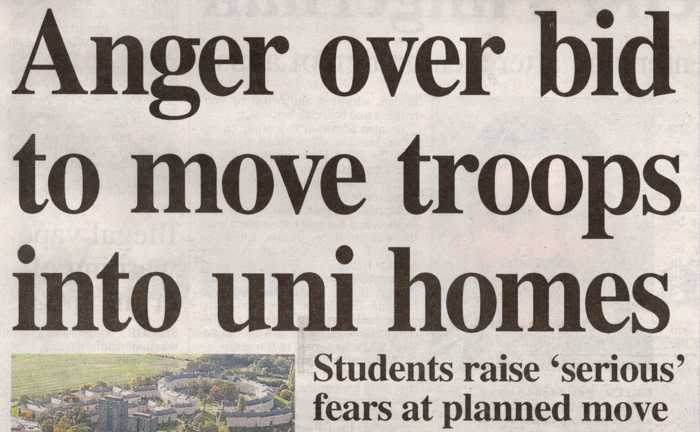
As you can see from the ECS headline, the university has begun a consultation exercise to determine whether it could rent some of its accommodation out to the army. Colchester is a garrison town, and its barracks are full to overflowing. Putting some squaddies and their families in university-owned accommodation suits both institutions well. It would be fixed-term, would guarantee an income, and would solve the army's problem too.
When this idea was proposed, the students naturally objected (hence the headline). They may claim to be progressive, but they're very keep-things-as-they-are when it comes to campus life. Their vague concerns as expressed to the media are to do with "safety", although they also have a gripe that they weren't consulted before the possibility of hooking up with the army was announced.
I realise that the army is supposed to be dangerous, because that's its job, but it doesn't follow that it's dangerous to students. It's more likely that students would be a danger to army discipline than that squaddies and their families would be a danger to student well-being.
The complaint about a lack of consultation is fair enough, but it depends how the matter was brought up. It's likely to have arisen because of the various existing ties that the army and university have. The current head of Colchester Garrison is a member of the University Court; it's easy to imagine an informal conversation with the present Vice Chancellor in which either he mentioned that the army had too little accommodation or she mentioned the university had too much, and they realised the synergy. It doesn't have to be that one organisation formally approached the other, so there wouldn't necessarily have been a pre-proposal meeting to discuss it at which student representatives would have been present. Of course, it could have gone through formal channels, but students would only have been consulted if the university was the organisation that initiated contact.
The students can complain about safety concerns all they like, but the university really does need to fill those empty rooms with people whose rent is covered. It also needs it to be on a fixed contract (so if student numbers recover, the rooms can be reclaimed), which rules out renting out flats to members of the general public.
As I see it, there are basically three groups of individuals that meet the university's criteria:
1) Soldiers and their families.
2) Asylum-seekers.
3) Homeless people.
Unless the students can think of another one, those are their options. It would be interesting to see what the result of a campus-wide poll would reveal to be their preference.